Sep 15, 2026 · Gift Ilevbare
How to Write a B2B Case Study That Closes Deals
73% of B2B buyers say case studies shape their purchase decisions. Only 34% of companies use them well. Here's how to be one of the 34%.
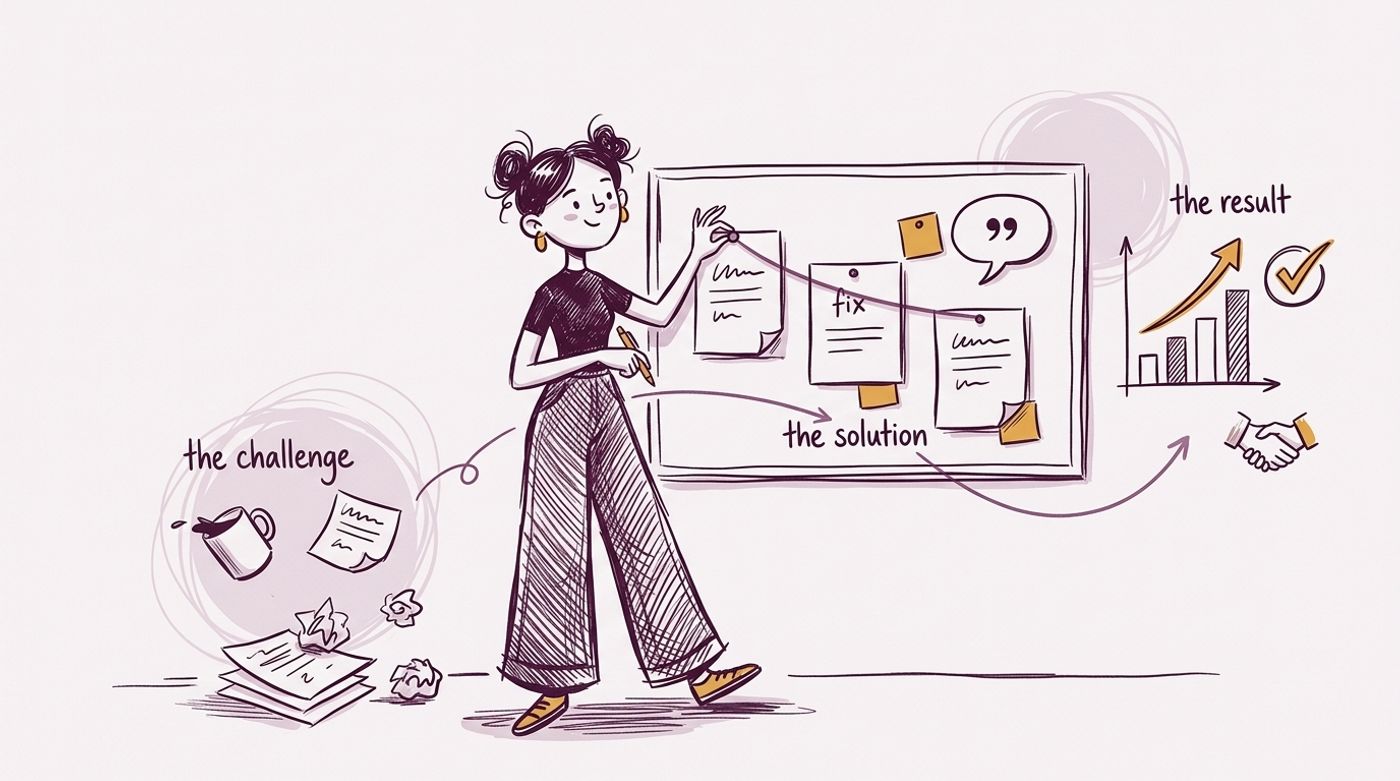
It might surprise you to learn that most B2B case studies don't close deals, not because they lack good customers or strong results, but because of how they're written. Yeah, that's right!
According to Content Marketing Institute's 2025 B2B research, case studies significantly influence the purchasing process for 73% of B2B decision-makers, yet only 34% of companies use them effectively.
In this article, I'll show you how to structure a B2B case study that gets read, from picking the right story to tell to a simple format you can reuse every time and a template you can steal for your next one.
Key Takeaways
- Lead with the outcome in the title. Put your clearest, most specific result in the headline instead of saving the number for later. This is what gets busy buyers to click and read.
- Structure matters more than length. A simple three-part flow from challenge to solution to result works better than a long, unfocused story. Buyers want to see the problem they recognize, what changed, and the measurable outcome.
- The customer’s problem outweighs their logo. Readers connect with a familiar struggle more than an impressive brand name; pick a story your target buyer sees themselves in.
- Specific, believable numbers win. Direct customer language and concrete metrics like “33% less overhead” or “10+ hours saved every week” are what buyers remember; “significant improvement” gets ignored.
- The best way to secure a case study is to ask right after a big win or renewal, keep the ask small, and offer to write a first draft the customer can review and correct.
What's the Right B2B Case Study Format?
How do you write a B2B case study that gets results? Structure. That's it, that's the whole secret (I know, anticlimactic).
Every strong B2B case study follows the same three-part structure: the challenge, the solution, and the result, but I’ll be starting with the title.
To make each part concrete, I'm going to break down a B2B case study section by section as we go: ClickUp's case study on Chick-fil-A. I picked this one on purpose; it's a clean example of every point I'm about to make.
The Title
Your title should lead with your best result. People treat the title as a placeholder and save the "good part" for later, but that's backwards. A title that already tells the reader what happened gets the click.
- Lead with the customer's name and the sharpest number you have.
- If the number needs context to make sense, save the context for the body, not the title.
- Avoid vague titles like "How We Helped [Company] Succeed"; name the actual win.

The Challenge
Think of this section as the moment the reader recognizes their own problem in someone else's story. That only works if the problem is specific; a vague problem doesn't make anyone feel understood.
- Name a concrete daily annoyance, not an abstract inefficiency.
- Include a number or frequency if you have one ("every week," "10 hours").
- Avoid making the customer look incompetent; frame it as a gap, not a failure.
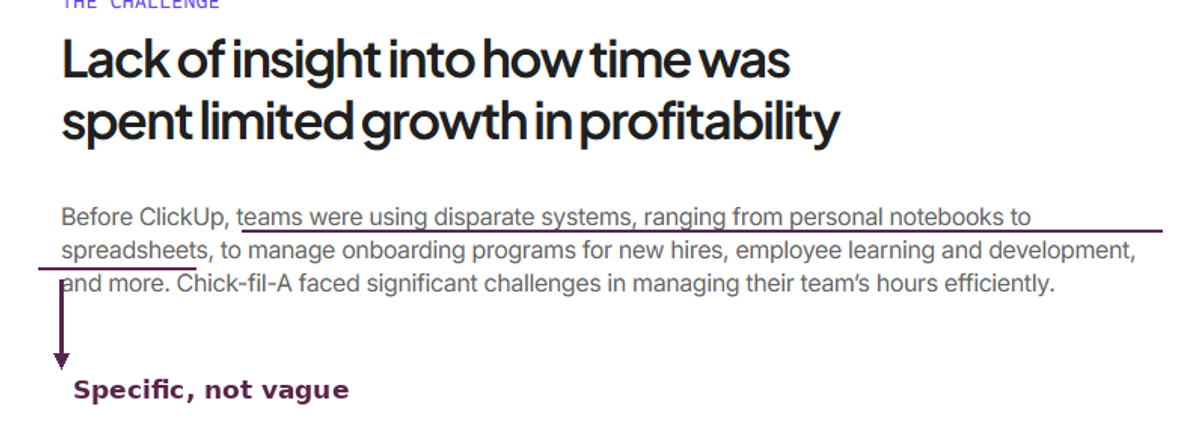
Let's look at how ClickUp wrote their Challenge section. Instead of describing the problem in vague terms, they showed what it looked like day-to-day: a team juggling scattered, disconnected tools to keep basic operations running, with nothing pulling it all together. As a reader, you can see yourself in this if it's a problem you've had too.
The Solution
This is the one section that trips up almost every case study I've read. They treat it like a chance to list everything the product does, when really it's just supposed to show what changed for the customer.
- Describe the customer's decision or change in behavior.
- Keep the focus on their experience of using it.
- One sentence naming the product is enough; the rest of the section belongs to the customer.
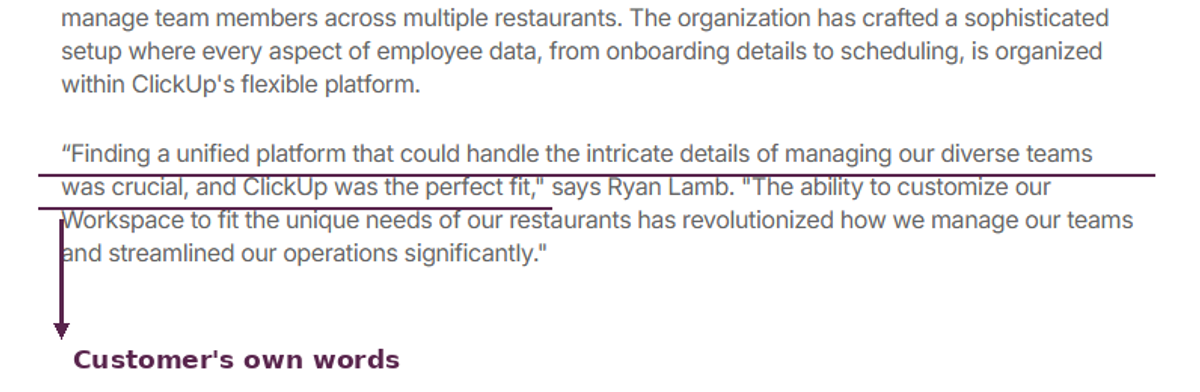
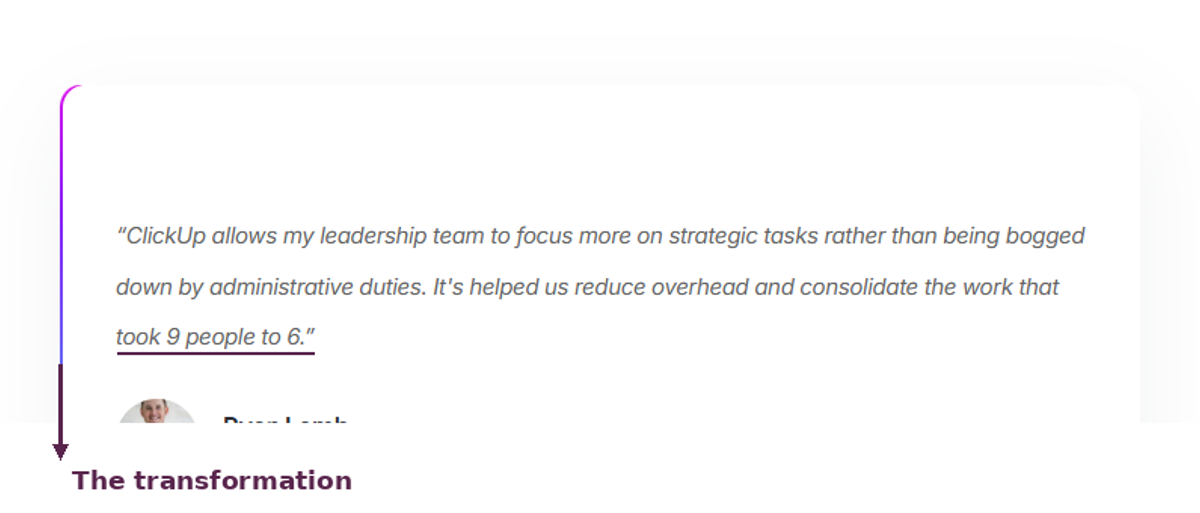
ClickUp's Solution section includes a direct quote from Ryan Lamb, the operating partner who felt this problem firsthand. Notice it's the customer's own words doing the convincing, not the brand's.
The Result
This section needs a proven, specific number the reader can repeat to someone else later. Vague improvement claims don't survive contact with a skeptical reader.
- Use a real number, not a general claim like "significant improvement."
- Keep the number believable; an outrageous one reads as fake before it reads as impressive.
- State it clearly; don't bury it in a longer sentence.
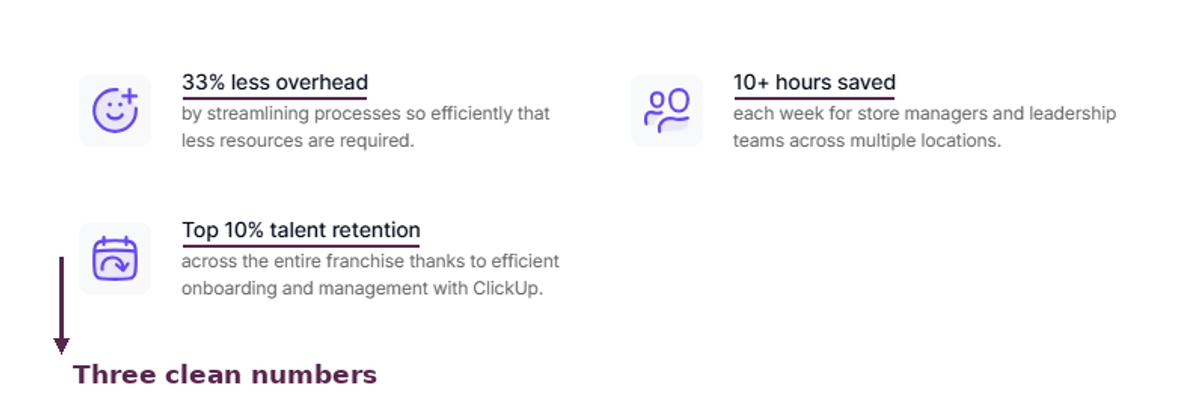
ClickUp's results section gives three clean numbers up front: 33% less overhead, 10+ hours saved every week, and top 10% talent retention.
Then it closes with the problem solved: the same work that used to take nine people now only takes six. If you read this, won't you remember it? I bet you will.
Grab your free B2B Case Study Toolkit, a fill-in template, interview questions, and a pre-publish checklist, with everything from this section in one place.
What Are the Key Elements of an Effective B2B Case Study?
Congratulations, you now know how to structure a B2B case study. But that's not all; structure alone doesn't guarantee it works. You need to know three more B2B case study best practices to help move buyers closer to saying yes.
Pick the Right Customer to Feature
Before you choose which customer to build your case study around, you need to know who you're trying to reach. Once you know that, look at your available customer stories and pick one your readers will see themselves in.
Your reader needs to see themselves as the hero of the story, not just admire someone else's. The strongest way to do that is to pick a customer close to your reader in size, role, or industry, but what matters most is that the problem or struggle is one your reader recognizes.
- Know your target reader first; the right customer choice follows from that, not the other way around.
- Start with the problem; ask which of your customers faced the exact struggle your reader is dealing with.
- Treat size, role, and industry as bonus points; they help, but a familiar problem carries more weight than a matching org chart.
- If you don't have a perfectly matching customer yet, a detailed story from an imperfect match still beats no case study.
Let the Customer Do the Talking
Make the case study about the customer as a person, not the company, and use their language verbatim wherever possible.
- Pull direct quotes from the actual conversation; don't paraphrase them into cleaner corporate language.
- Make the customer tell the story.
- If a quote sounds too polished or too much like your own website copy, it probably needs to go back to what your customer said.
I always suggest using the customer's actual words because it makes the case study harder to dismiss. It makes it… believable and trustworthy.
Lead With the Outcome
Headlines should lead with the result. A big company name only helps if the result backing it up is just as strong.
- Put the result in the headline before the customer's name if the result is the more interesting part.
- Don't rely on a recognizable brand to carry a weak or vague result.
- A specific, believable number from a smaller company beats an impressive-sounding but vague claim from a big one.
How Do You Get the Customer's Story?
Getting the customer's story is the hardest part of writing a B2B case study, maybe harder than the writing itself. You can know the format and still end up with nothing usable if this part goes wrong. Here's the three-part process I use with my clients when working on a case study.
Ask at the Right Moment
Something as small as timing can decide if you get a yes. Right after a customer hits a real win or renews, they're still proud of it and want to talk about it. Wait too long, and that feeling fades, and so does their willingness to say yes.
Keeping the ask small helps too: instead of requesting a full interview, write a first draft yourself using what you already know about their experience, things like usage data, notes from sales or support conversations, or results you've already tracked internally.
Then ask them to review and correct it. That's a much easier yes than "Can we schedule an hour to talk?"
Plan the Interview Before It Happens
If you do go the interview route, know roughly what result you're hoping to highlight before you start. Send your questions ahead of time so the customer isn't caught off guard trying to answer on the spot.
Then structure the actual conversation in three parts: what life looked like before, what changed and how it felt, and what's next for them.
Before the interview, make sure you:
- Send your questions in advance; a prepared customer gives you better answers.
- Ask about feelings and outcomes.
- Save your best for last; ask them to restate their answer as a full sentence so you get a clean, usable quote.
Expect Approval Bottlenecks
Getting someone to talk isn't the problem; getting their internal sign-off afterward is. These are patterns and solutions I've pulled from product marketers discussing this problem online.
| Why sign-off stalls | What helps |
|---|---|
| Legal or brand teams need to approve anything using their name and logo. | Offer an unbranded version as a fallback so the story can still be used without the company name attached. |
| The customer is in a regulated or competitive industry and doesn’t want public exposure. | Accept this upfront as a limitation. Some customers will never say yes, no matter how strong the ask is. |
| Scheduling an interview feels like work for the customer. | Write the first draft yourself based on what you already know, then ask the customer to approve or edit it. |
| Larger companies route approval through legal, marketing, and product teams. | Set the expectation early that this can take weeks or months, and offer a smaller option too, like a short testimonial instead of a full case study, so saying yes doesn't feel like one big commitment. |
| The customer's champion (the person inside the company who loves your product and pushed for buying it) doesn't see what's in it for them personally to spend their time helping. | Frame their participation around what they personally gain, like looking good to their own boss for a smart decision. |
| A request from marketing feels like corporate admin work to a busy customer. | Have whoever already has the relationship, whether that's sales or customer success, make the ask instead; it feels like a person asking a favor, not a company asking for content. |
Your Job Isn't Done at Publishing
Writing the case study is only half the job. Once it's done, someone still has to get it in front of your sales team and your buyers, or it just sits on your website doing nothing.
If you don't have the time to write one yourself, or you'd rather hand it to someone who already knows how to do this well, that's exactly what I do. See more of my work → or let's talk →
FAQ
What is a B2B case study?
A real customer's story, told through a specific problem, what fixed it, and the measurable result that followed. It's not the same as a testimonial; a testimonial is a quote of praise, and a case study is proof.
How do you write a compelling B2B case study?
Put the result in the title, use the customer's exact words instead of polished brand language, and pick a specific number over a vague claim.
How long should a B2B case study be?
Most effective ones run somewhere between 600 and 1,200 words, long enough to include detail and numbers, and short enough that a busy buyer finishes it.
How do you write a B2B SaaS case study?
The structure is the same, but a SaaS case study needs to speak to a more technical reader and connect the result back to trial signups, retention, money, or time saved inside the product.
What if you don't have a customer story big enough for a case study yet?
Still start. A clear, specific result from one small customer beats no case study at all; you can always feature a bigger name once you have one.